
Window Styles & Comparisons
Box Bay Window: What It Is and Why You Might Want One
If you've been researching bay windows and keep coming across the term box bay window, you're not alone. It sounds like it could mean the same thing as a bay window, but it doesn't, and it’s important to learn the difference if you're trying to figure out which style fits your home.
This article covers box bay windows specifically: what they are, how they compare to standard bay windows, where to install them, and how to get the most out of the space they create inside!
What Is a Box Bay Window?

A box bay window is a bay window type that projects outward from the exterior wall of a home, just like a standard bay window. But unlike a standard bay window with angled side panels, a box bay has a flat front and two side panels that extend from the wall at a 90-degree angle. Looking at it from above, the shape is a rectangle, which is exactly where its name comes from.
The three windows (if the middle panel is large enough, there may be three or more windows) are arranged like a squared-off U: two narrower panels on the sides, and one or more large windows facing straight out. From the outside, the look is clean and sharp-edged. From the inside, you get a defined rectangular ledge and a proper bump-out you can actually use. Sometimes, box bay windows also have a glass roof.
Box bay windows are sometimes confused with garden windows, which are actually smaller and typically installed in kitchens, usually with the purpose of growing flowers on their sills.
What Is a Box Bay Window’s Depth?
Most box bay windows project between 16 and 24 inches from the exterior wall. Shallower projections are common in kitchens, where the goal is a deep sill for plants or a small shelf rather than a full seating area. Deeper projections, from 18 to 24 inches, are typical in living rooms and bedrooms where a window seat or bench is part of the plan.
The depth you choose affects more than the interior ledge. A deeper box bay adds more visual weight to the exterior, requires more structural support underneath, and costs more to install. It also changes the light quality inside. A shallower bay lets light in at a wider angle, while a deeper one channels light more directly from the front panel.
As a general rule, if you want a usable window seat, aim for at least 18 inches of interior depth. Anything under 16 inches is more of a wide sill than a bump-out. Anything over 24 inches starts to feel like an addition and should be planned with a contractor from the beginning.
Box Bay Window vs. Bay Window: What's the Difference?

A traditional bay window uses angled side panels, most commonly at 30 or 45 degrees. That angle gives it the softly faceted shape you probably picture when you hear bay window. Bay and bow windows get grouped together often because both use that geometry; bow window options offer a curved profile created by four or more windows.
A box bay drops the 45-degree angles. The sides come straight out from the wall, and the front sits parallel to it, forming 90-degree angles. That makes the projection deeper for the same width, because you're not losing floor space to diagonal cuts. You also get a flat, rectangular ledge inside rather than a tapered one.
From the outside, a box bay is bolder and more geometric. If your home has a modern, craftsman, or otherwise clean-lined exterior, that reads well. If your home is traditional or Victorian, a standard bay with angled panels will usually look more proportional.
If you're planning to use the interior bump-out for seating or storage, a box bay gives you more workable space than a simple bay window. The rectangular footprint is just easier to build around.
Pros of Box Bay Windows
- More usable interior space. The sides are perpendicular to the wall, so the floor area inside the bump-out is rectangular. You can fit a bench, storage drawers, or a proper window seat without designing around awkward angles.
- Deeper projection for the same width. A box bay can extend further from the wall than an angled bay of equal width. That depth gives you a more substantial interior ledge or seating area and can significantly enhance curb appeal and increase home value.
- Simpler window coverings. Flat panels are easy to cover with blinds, shades, or shutters. No awkward angles to work around.
- Suits modern architecture. If your home has clean lines, a box bay fits without looking forced.
Cons of Box Bay Windows
- Not the right fit for traditional homes. If your exterior has ornate trim, curves, or Victorian detailing, a box bay can look out of place. Angled bay windows generally read better on those styles. Bow windows offer more architectural details for such buildings as well.
- Requires proper structural support. Because the side panels are perpendicular, not angled, the load distribution is different. Depending on the size and placement, you may need a stronger header or a knee wall underneath. A contractor or window specialist should assess this before installation.
- Proportions matter. The geometry is unforgiving. A box bay that's too narrow for the wall it's on, or installed without careful trim detailing, will look off. Getting the sizing right matters more here than with a traditional bay.
- Less visual softness on the exterior. Some homeowners prefer the gentler shape of a traditional bay or bow window. That's a personal call, but it's worth looking at examples before deciding.
Box Bay Window Combinations
One of the decisions that gets glossed over in most buying guides is which window types you can actually put inside a box bay. The frame is just the container. The window combination determines how much light comes in, how much ventilation you get, and what the whole installation looks like from inside and out.
Here are the most common configurations for box bay windows and where each one makes sense.
Picture Window Flanked by Casement Windows
This is the most popular combination. A large fixed picture window in the center gives you more glass for panoramic views. The two casement windows on the sides crank open outward, so they don't encroach on the interior space when open. This combination works well in living rooms, bedrooms, and home offices, basically anywhere you want a clear sightline plus ventilation.
One thing to check: casement windows on a box bay swing outward, so make sure there's clearance on the exterior. If the box bay sits close to a walkway or patio, an open casement could block foot traffic.
Picture Window Flanked by Hung Windows
Swapping the casements for single-hung or double-hung windows gives you a more traditional look. Hung windows are the classic North American window: the sash slides up and down rather than swinging out. This makes them a natural fit for homes with colonial, craftsman, or heritage-style trim.
The trade-off is ventilation. A double-hung window only opens half its frame area at a time (either the top or bottom sash), unless it also tilts inward, while a casement opens the full panel. If airflow is a priority, casements do better. If the look of the home matters more, double-hung windows often integrate more naturally.
Picture Windows on All Three Sides with Awning Windows on Top

This configuration maximizes glass and keeps the view unobstructed across all three panels. Awning windows, hinged at the top and opening outward from the bottom, sit above each picture window, giving you ventilation without cutting into the main view below.
It works well in rooms where you want a lot of light and an open feel, like a living room with a garden view or a bedroom that looks out over a backyard. The awning windows let in a breeze even during light rain, which is a practical bonus in Toronto's climate. From the outside, the result is a clean band of glass with a thin operable strip above.
Picture Window + Two Casements in the Middle, Flanked by Two Casements
This is the wider, more expansive version of the standard picture-and-casement combination. Instead of three panels, you're working with five: a large center picture window, two casements on each side (on the same middle panel), and two more casements flanking the middle panel.
This combination works when the box bay is wide enough to justify the scale, typically eight feet or more across. The result is a lot of glass, a lot of ventilation, and a window that becomes a real architectural feature on the exterior. In a larger living room or an open-plan main floor, this configuration fills the wall well. The installation is more complex, and the cost is higher, but for the right space, it's the most substantial of the standard configurations.
All Double-Hung Windows
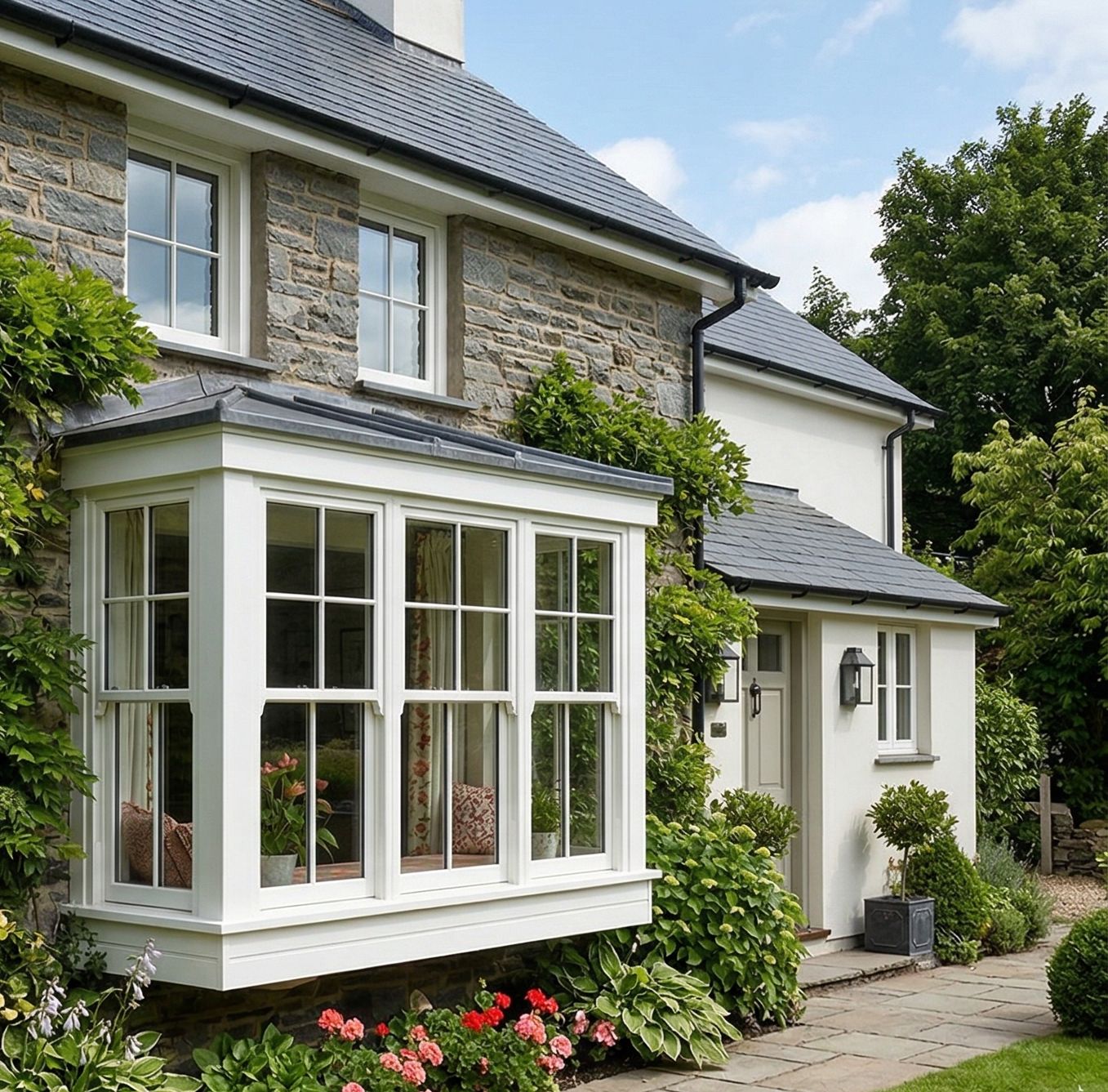
Three double-hung windows across the box bay, one on each panel, is the most traditional configuration available. It reads as classic, fits naturally on older Toronto homes, and is often the most affordable option because double-hung windows are the most widely produced window type.
Ventilation is decent when you open both the center and side panels, though each panel only opens to half its full area. For a bedroom or home office where full airflow isn't critical, this works fine. For a kitchen or a room where you need to move hot air out quickly, it's less effective.
All Casement Windows
Three casement windows across the box bay give you maximum ventilation across the full width. Every panel opens to its full size.
From a design standpoint, all-casement box bays have a clean, contemporary look. The hardware is consistent, and the sightlines are uniform across all three panels. If your house has modern or minimalist detailing, this combination is definitely worth considering.
Where to Install a Box Bay Window
The right location depends on what you want the window to do.
Living rooms and family rooms are the most common choice. A box bay on the main wall of a living room adds depth, brings in more light, and creates a natural focal point. If there's any kind of view, even a modest garden or streetscape, it might be worth it to frame it with a box bay.
Kitchens are also suitable for box bay windows, especially when installed above the sink or on an exterior wall near the counter. Plus, a box bay window in the kitchen gives you a sill deep enough for herbs or small plants, pulls more natural light into a work area, and makes the room feel bigger without a renovation. You can also install box bay windows in the dining area and use the extra space for a breakfast nook or a dining table.
Primary bedrooms can accommodate box bay windows, too, when there's enough wall space. The interior ledge can be turned into a reading bench, a spot for a lamp and a plant, or just a place to sit in the morning and enjoy a warm cup of coffee. The operable side panels also help with cross-ventilation, which matters in a bedroom.
Box bay windows can also work wonderfully in a home office. Natural light helps with focus, and the ledge doubles as a secondary surface. If your office has an exterior wall and you're looking for a reason to improve the space, a box bay is worth the thought.
How to Dress a Box Bay Window?
Covering a box bay is actually easier than covering a bow window, for instance, but you still have a few decisions to make. Here are some options you may want to consider:
- Cellular shades or roller shades are usually the best for bay windows. You mount individual shades on each of the three panels, which gives you control over light section by section. They sit flat against the glass and don't fight the window geometry.
- Plantation shutters work well because the flat panels give you a clean surface to mount them on. They're easy to operate, fit most interior styles, and handle both light control and privacy without a lot of fuss.
- Curtains or drapes work if you want a softer look. The most practical approach is a single rod spanning the full width of the box bay.
- Roman shades are softer than shutters, but more structured than drapes. They work particularly well in kitchens and bedrooms where you want the window to look put-together without a lot of fabric in the frame.
- Retractable blinds are often favored for bay windows because they remain hidden when not in use. Magic’s solar shades and thermal blinds, for example, stay hidden within the window frame when you want to bring in natural light or enjoy the views. To cover the windows, all you have to do is pull the blinds out of their cartridges. Also, they can be installed separately on each window.
One thing to keep in mind, regardless of what you choose: Toronto winters are hard on poorly sealed windows and coverings. So, whatever you install should fit close to the frame to cut down on drafts and heat loss.
How to Use the Extra Space a Box Bay Window Creates

The interior bump-out is one of the main reasons people choose a box bay over a flat window or a traditional bay.
You can use that space as a window seat with storage, for instance. All you have to do is install a bench across the full width of the box bay with a hinged lid storage underneath. This is the most popular option because it solves two things at once: seating in a spot that would otherwise just be a ledge, and hidden storage for extra blankets, kids' toys, or anything else that needs a home.
Also, what about a reading nook? Every bookworm’s dream! Add a cushion, a few pillows, and a small side table, and you’ve got the perfect spot for enjoying those books that have been waiting on your to-be-read list forever!
If your box bay window is above the counter in your kitchen, use it as a herb shelf for basil, rosemary, thyme, small succulents… and anything else! It catches light from multiple angles, and the sill is deep enough for a proper row of pots.
And, of course, the simplest option: use the ledge for displaying plants, books, or objects that look good in natural light. A few well-chosen things on a box bay sill can anchor a room without a lot of effort.
What to Look for When Buying a Box Bay Window in Toronto
A few things are worth paying attention to, given our climate in Toronto, including:
- Glass performance. Look for double or triple-pane glazing with low-E coatings. The low-E layer reflects heat back into the room in winter and deflects solar heat in summer. The ENERGY STAR Canada rating is a solid baseline. It means the window meets performance minimums for the climate zone.
- Frame material. Vinyl is the most common choice in Ontario because it handles freeze-thaw cycles, doesn't need painting, and insulates well. Fiberglass costs more but is dimensionally stable, meaning it expands and contracts less with temperature changes. Wood is an option if you want the look, but it requires more upkeep. The best option, though, is a hybrid material like Magic’s Hybrid Fusion Frame, which consists of aluminum, steel, and vinyl.
- Structural support. A box bay needs either a knee wall underneath or a proper bracket system to carry the load. If you're replacing a flat window with a box bay, that support structure is part of the installation. Make sure whoever you're working with has experience in installing and securing box bay windows.
How Much Do Box Bay Windows Cost?
In Toronto, a typical box bay window installation runs between $3,500 and $8,000 or more, depending on size, glass package, frame material, and the complexity of the structural support. Here's how those variables break down:
- Size and number of panels. A three-panel box bay with a picture window and two casements costs less than a five-panel configuration. Wider projections also require more robust support underneath, which adds to the labour cost.
- Glass package. Double-pane glass with a standard low-E coating is the standard. If you upgrade to triple-pane or add a higher-performance coating for better solar control, expect the cost to increase. Still, in Toronto's climate, the energy savings from a better glass package tend to pay back over time. You may also be eligible for government rebates.
- Frame material. Vinyl is the most affordable and the most common, but it often has a shorter lifespan than hybrid materials. Fiberglass and hybrid frames cost roughly 20-30% more but perform better in extreme temperature swings.
- Structural work. If your home needs a new header, a knee wall, or a bracket system to support the projection, that work is separate from the window cost. For a straightforward installation in a newer home, this might add $500 to $1,000. For an older house with a non-standard wall assembly or a large projection, it can be more.
- Finishing. Interior trim, exterior capping, and any built-in bench or shelf work add to the total. Some homeowners price the window installation separately from the carpentry, which is also fine, just make sure you're accounting for the full project cost when you budget.
Looking for Box Bay Windows? Get the Right Ones with Magic!
At Magic, quotes are based on your specific project rather than a catalog price. For box bay windows, a site assessment is the only reliable way to get an accurate number. The team can walk you through the options that make sense for your home and give you a clear breakdown of what's included in the final cost.
Book your free consultation today on our website to explore our product lines and advanced window technologies that improve window functionality, energy efficiency, and durability! And don't be afraid to share your ideas with us - our teams are eager to work on the most interesting design ideas out there!
Most Frequently Asked Questions about Box Bay Windows
What should I choose: bow window, bay window, or box bay window?
It depends on your home's exterior style and what you want to do with the interior space. Bow windows suit curved, traditional facades and maximize panoramic views; standard bay windows with angled panels work well on heritage or Victorian homes; and box bay windows are the right call when you want a contemporary look and a rectangular bump-out you can actually use for seating or storage.
What is the difference between a box window and a bay window?
A bay window uses angled side panels, typically at 30 or 45 degrees, which gives it a softer, faceted shape on the exterior. A box bay window has side panels that extend at a 90-degree angle, creating a rectangular projection with a flat front and a deeper, more usable interior ledge.
How much does a box bay window cost?
In Toronto, a typical box bay window installation runs between $3,500 and $8,000 or more, depending on the number of panels, glass package, frame material, and any structural work required. The cost varies significantly from project to project, so a site assessment is the most reliable way to get an accurate number.
What is a box bay window called?
A box bay window goes by a few names: you'll see it referred to as a square bay window, a flat bay window, or sometimes a garden window when it's a smaller version installed in a kitchen. They all describe the same thing: a window that projects from the wall with 90-degree side panels, not angled ones.
Do you need planning permission for a box bay window?
In Toronto, you'll typically need a permit if the work for installing a box bay window involves structural changes to the exterior wall. The specifics depend on your property and the scope of the installation, so it's worth asking your contractor before work begins.