Window Styles & Comparisons
Soundproof Windows: Everything You Need to Know Before You Buy
If you live near a busy road, a flight path, or a noisy neighbourhood, you already know how much the outside sound affects your daily life. You have to sleep through traffic or focus hard while working from home, and you can’t simply relax in your living room because it’s too noisy.
Obviously, there are plenty of ways to soundproof your home. One of them is installing soundproof windows that can make a real difference. But before you invest, there's quite a lot to understand about how they work, what the ratings actually mean, and which features matter most for your specific situation.
Key Facts: Soundproof Windows
- No window is 100% soundproof, but the right combination of glass, frame, and installation can reduce outside noise by up to 90-95%.
- STC (Sound Transmission Class) is a rating used to measure how soundproof a window is. The higher the rating, the more sound a window blocks.
- The three biggest factors in window sound reduction are glass mass, air gap width, and seal quality. All three need to work together.
- Laminated glass, double- or triple-pane windows, and an airtight seal are the most effective upgrades for noise reduction.
- Professional installation matters as much as the window itself. A small gap can undo the performance of even the best window.
- Magic's Hybrid Fusion Frame, welded corners, and 1-inch insulated glass units give our windows better sound performance than standard vinyl frames.
What Are Soundproof Windows?

Soundproof windows are replacement windows designed to reduce the amount of outside noise that enters your home. They use thicker glass, more glass layers, wider air gaps between panes, and tighter seals to block sound.
It's worth knowing upfront that no window eliminates noise completely. What soundproof windows do is reduce noise to a level where it's no longer disruptive. Common sounds like traffic, neighbours, barking dogs, and general urban noise can go from constantly present to barely noticeable.
You'll see soundproof windows called acoustic windows, noise-reducing windows, or sound control windows. These terms all refer to the same idea: windows built specifically to perform better at blocking sound than a standard replacement window.
How Do Soundproof Windows Work?
Sound is a vibration that travels through air and solid materials. When noise hits your window, it causes the glass to vibrate, and those vibrations pass through to the air inside your house. Soundproof windows reduce this transfer through three main mechanisms.
Mass
Heavier, thicker glass vibrates less. The more mass a pane has, the harder it is for sound waves to move it. This is why thicker glass always performs better than thinner glass at blocking noise.
Air/Inert Gas Gap
The space between glass panes acts as a buffer that breaks up sound vibration. Sound has to travel through the first pane, cross the air or inert gas gap, then travel through the second pane. Each transition weakens it. A wider air or inert gas gap generally means better sound reduction, which is why the size of the gap matters as much as the glass itself.
Damping
Certain materials absorb vibration instead of transmitting it. Laminated glass, which contains a plastic interlayer bonded between two glass sheets, is the best example. The interlayer absorbs and dissipates sounds before they can pass through.
These three mechanisms work best together. A window with thick glass, a wide air gap, and laminated panes will always outperform one that only addresses one of these factors.
What Is Sound Transmission Class (STC)?
Sound Transmission Class (STC) measures how well a window blocks airborne sounds like voices, music, dogs barking, and general street noise. The higher the number, the better the window blocks sound.
High‑performance acoustic windows with STC ratings around 40-50 can make outside noise much quieter, often subjectively cutting loudness by more than half. But they won’t create complete silence. Plus, real‑world results depend heavily on the building and noise source.
Here’s a quick comparison of STC ratings for different types of windows:
The 4 Biggest Factors in Window Sound Performance
1. Glass Thickness and Type
Thicker glass has more mass, which means it's harder for sound to vibrate through. Standard windows use 3 mm (0.11 in) glass panes. Soundproof windows typically have panes with a thickness of up to 6 mm (0.23 in). Laminated versions also have an interlayer that further disrupts sound transmission.
Laminated glass bonds two glass sheets around a plastic (PVB) interlayer. This design prevents shattering and improves STC by several points over standard glass of the same thickness. If you're dealing with traffic noise or aircraft noise, laminated glass is one of the most effective upgrades available, especially since both of the glass sheets can be thick.
Mismatched glass thickness is another technique used in acoustic windows. Using panes of different thicknesses (e.g., 4 mm (0.15 in) on the outside and 6 mm (0.23 in) on the inside) can further reduce noise pollution.
2. Air Gap Width
The gap between glass panes is one of the most underrated factors in sound reduction. Standard windows use a gap measuring ½ - ¾ of an inch because that's ideal for thermal efficiency. But for sound, a wider gap is almost always better.
At Magic, our double-glazed windows use 1-inch gaps, wider than those used by most competitors. This wider gap lets us inject 20-30% more argon gas, improving insulation and sound reduction at the same time.
3. Frame Material and Construction
The frame matters more than most people realize. A tight, well-constructed frame holds the glass securely, reduces vibration transfer, and maintains the seal quality over time.
Here's how common frame materials compare for sound performance:
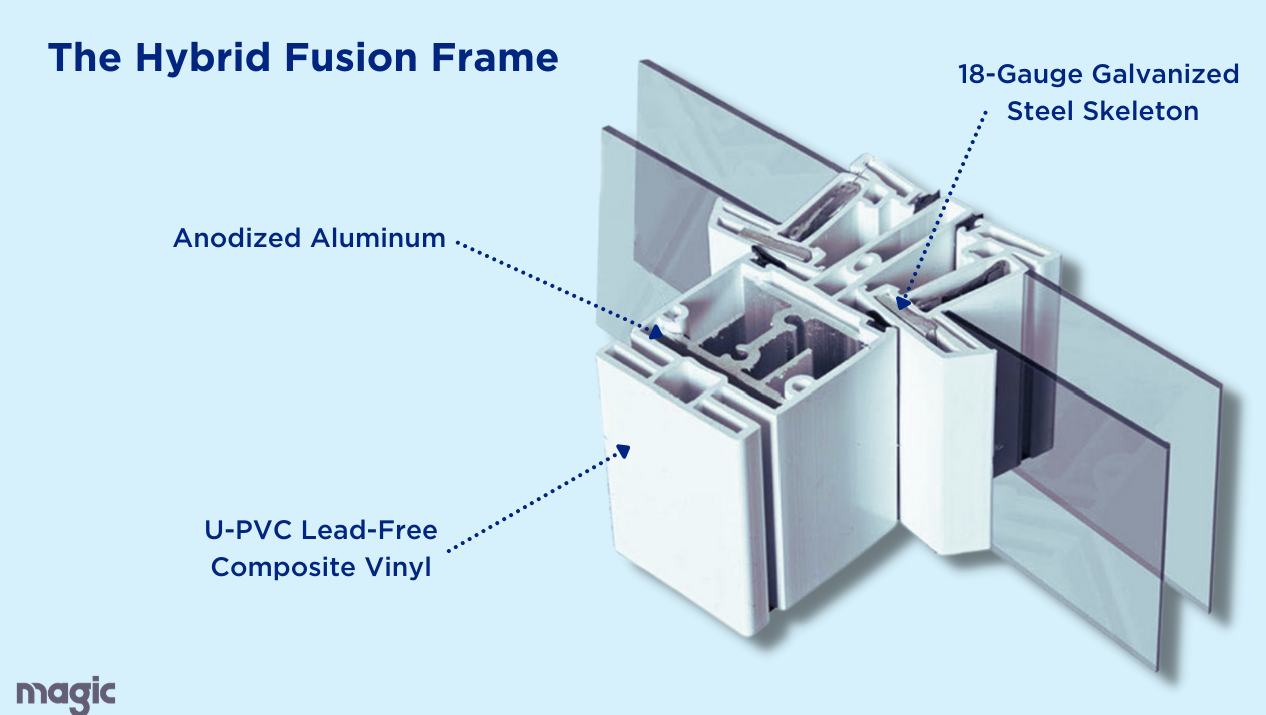
Vinyl frames with multiple air chambers perform well. Magic's Hybrid Fusion Frame, vinyl reinforced with a stainless steel and aluminum skeleton, performs better than standard vinyl because the rigid skeleton prevents the frame from flexing, warping, and cracking.
Furthermore, the window style matters as well. Casement windows, for example, seal more tightly compared to hung windows or sliding windows, regardless of their frame material and glazing.
4. Seal Quality and Installation
Sound follows air. If there's any gap around the frame, between the sash and frame, or along the perimeter seal, sound will find it.
Professional installation ensures that the window is plumb, square, and sealed correctly, and that the frame is insulated between the rough opening and the wall structure.
At Magic, our welded frame corners (unlike mechanically fastened windows held by screws) create a continuous, tight seal. Moreover, our experienced installation teams can guarantee professional installation, so your windows perform well year-round, regardless of weather conditions and outdoor noise.
Types of Soundproof Windows
Here are several types of soundproof windows.
Replacement Windows
Installing a full replacement window implies removing the existing frame and glass and replacing the entire unit. This gives you the best opportunity to install a properly sealed, high-performance window with the right glass and frame combination. It's the most effective long-term solution.
Window Inserts
Window inserts sit inside your existing window frame, adding a second layer of glass and an air gap. They're less invasive and less expensive than full replacements, and they can be effective. But their performance depends heavily on how well they seal against your existing frame. If the existing frame is warped, older, or poorly sealed, inserts won't perform as well.
Acoustic Grade Windows
Some manufacturers offer windows built specifically to acoustic specifications, using laminated glass, wider-than-standard air gaps, and acoustic sealants throughout. These are the highest-performing options and are typically used in areas with significant noise problems, such as near airports, highways, or train lines.
Secondary Glazing
Secondary glazing is not the same as window inserts. It's basically a separate window built to fit near the existing window. This option is usually used to improve the energy efficiency and soundproofing capabilities of single-pane windows.
Double-Pane vs Triple-Pane: Which Is Better for Sound?
This is a question we get a lot. Whether you should install double-pane or triple-pane windows for noise reduction depends on how the window is built, not just how many panes it has.
A standard double-pane window has an STC of 26-33. A standard window with three panes of glass has an STC of 32-36.
That said, a well-built double-pane window with a 1-inch gap and laminated glass can outperform a standard triple-pane window with thinner standard glass and two narrow gaps. The configuration matters more than the number of panes. You can also get double-pane windows with dissimilar glass thickness to further increase their STC.
That said, triple-pane windows with dissimilar glass thicknesses and laminated inner panes do provide the best acoustic performance available. But they're also heavier, which means your frames need to be strong enough to support them without flexing over time. The gaps between the panes are also smaller. And these windows are much more expensive.
If you want our honest take, Magic's double-pane windows equipped with our thermal blinds are more than enough for most Toronto homeowners looking for windows with soundproofing properties. But if you live near airports or major highways, it’s probably best to invest in triple-pane windows.
Soundproofing Beyond the Glass: What Else Affects Noise Levels?
Even the best soundproof windows can only do so much if other parts of your home are letting sound in. Here are the factors worth checking alongside your windows.
- Weatherstripping and caulking: old or deteriorated weatherstripping around the window frame is one of the most common causes of noise leakage. Replacing it is inexpensive and makes a measurable difference.
- Window treatments: thick curtains, cellular shades, and thermal blinds all add some sound absorption. Magic's thermal blinds, for example, add an extra layer of insulation and also reduce noise transmission; they act similarly to a third pane of glass in terms of energy performance.
- Wall and ceiling insulation: sound enters through more than just windows. If your walls have inadequate insulation, fixing your windows will help, but won't solve the problem completely.
- Ventilation openings: air vents, gaps around electrical outlets, and poorly sealed doors all contribute to noise. A quieter home requires looking at the whole picture.
How Much Do Soundproof Windows Cost?
Noise-reduction windows cost more than standard replacement windows, typically 10-30% more per window. The final price depends on window size, frame material, glass type, number of panes, and installation complexity.
Here's a general cost range to give you an idea:
These ranges vary significantly by region, window size, and supplier. The best way to get an accurate number for your home is a free in-home consultation with a window company.
Do Soundproof Windows Also Improve Energy Efficiency?
Soundproof windows definitely improve energy efficiency. This is one of the most practical reasons to invest in them. The features that reduce sound also reduce heat transfer.
More glass layers, wider air gaps, more argon gas, better seals, and better frames all contribute to a lower U-factor (the measure of heat loss), which means lower energy bills year-round. Soundproof windows and energy-efficient windows are built on the same principles.
Magic's double-pane windows with our retractable thermal blinds, for example, have a U-value of 0.17, one of the lowest U-factors available, and comparable to many triple-pane configurations. You're getting both sound reduction and energy savings in the same product.
Ultimately, the investment pays back through energy savings and improved home comfort over time. Plus, you might also be eligible for window rebates if you install ENERGY STAR-certified units.
What to Look for When Buying Soundproof Windows
Before you talk to any window company, here's what you should ask about or look for:
- STC ratings. Get the actual test data, not just marketing claims.
- Glass configuration. Find out the thickness of each pane, whether laminated glass is included, and the exact air gap measurement.
- Frame material and construction. Ask if the frame corners are welded or mechanically fastened. Welded corners maintain a better long-term seal.
- Seal and weatherstripping quality. Ask what materials are used and how long they're covered under warranty.
- Installation approach. Confirm that the installers have experience in installing your specific windows (e.g., bay and bow windows are much more difficult to install, so not all teams can do that).
How to Soundproof Windows
If you’re not ready to replace your windows yet, here are some methods you can try to sound proof windows:
- Install window inserts or storm windows.
- Replace old caulk with acoustic caulk (usually latex caulk).
- Hang acoustic curtains.
- Install secondary glazing (no, not another layer of glass and not a window insert, but a separate, independent window built to fit just like the existing window).
- Install noise-reducing blinds or shades.
- Apply window foam or soundproofing panels.
- Use mass-loaded vinyl to dampen sound vibrations.
Ready to Reduce the Noise? Book a Free Consultation with Magic!
If you're dealing with noise problems and want to know exactly what windows you need, we're here to help. Book a free in-home consultation with Magic, and one of our project managers will assess your windows, explain your options, and recommend the right solution for your budget and situation.
Our windows are made right here in southern Ontario and installed by our own certified teams. We'll handle everything from product selection to proper installation, and back it all with our industry-leading 40-year warranty.
Contact Magic today and book your free in-home consultation!
Frequently Asked Questions
Do soundproof curtains for windows work?
Soundproof curtains for windows do work by reducing echo and absorbing some sound waves inside the room. But they don’t block noise coming through the glass because they don’t act like a solid wall or a new window.
How can I make my windows soundproof?
You can make your windows soundproof by upgrading to windows with thicker or laminated glass, a wider air gap between panes, and a proper airtight seal around the frame. If your current windows are older than 15-20 years, full replacement will deliver better results than any add-on fix. If you’re not ready to replace your windows, you can install a window insert or secondary glazing, replace old caulk with acoustic caulk, or use noise-dampening materials.
Do soundproof windows really work?
Yes, a high-quality soundproof window can reduce perceived noise by 90-95%, making traffic, neighbours, and general urban noise barely noticeable. The results depend on the glass configuration, frame quality, and how well the window is installed.
What are the best windows to keep noise out?
Laminated double or triple pane windows deliver the best noise reduction available.
Do soundproof windows block all noise?
No window blocks 100% of exterior noise. However, a high-quality soundproof window can reduce perceived noise by 90-95%, making intrusive sounds barely noticeable.