Front Doors
Top 13 Door Hinges Types and Their Uses
Maybe your door is squeaking, sagging, slamming shut too hard... Or maybe you're installing a new door and want the best door hinges on the market. Either way, chances are you're trying to identify the right hinge that will actually fit your door.
So, what door hinges types should you consider for your door and which ones should you ignore completely? Let's find out!
Key Takeaways
- Different door hinges are designed for different door weights, movement styles, and environments, so the right choice depends on how and where the door is used.
- Some hinge types are made to handle heavy doors, some are designed to stay completely hidden, and others are built to close doors automatically or allow wider opening angles.
- Choosing the correct door hinge type reduces noise, prevents sagging, protects the door and frame, and makes everyday use smoother and quieter.
Basic Door Hinge Components
Before we discuss different types of door hinges, let's define their components:
- Leaves - the flat metal hinge plates that attach to the door and frame; each leaf has screw holes that secure it to the surface.
- Knuckles - hollow cylindrical tubes where the hinge leaves meet; multiple knuckles interlock together to form the joint; they work like the hinge's elbow, allowing the door to move smoothly.
- Pin - the metal rod that passes through the hollow center of the knuckles; the pin holds the leaves locked together so they can rotate as one unit; without the pin, the hinge would fall apart.
When you open and close a door, the pin stays still while the knuckles rotate around it, letting the leaves swing outward or inward.
Furthermore, keep in mind that door hinges are typically grouped into mortise hinges (which need a recess cut into the edge of the door and into the frame) and non-mortise hinges (which can be screwed onto the surface of the door and the surface of the frame).
Door hinges are also grouped by visibility (concealed vs visible), function (self-closing, friction, pivot, etc.), and application: cabinet hinges, entry door hinges, gate hinges etc.).
13 Types of Hinges for Doors
In the following sections, we'll discuss the 13 most common types of door hinges, outlining their operation, advantages, disadvantages, and best uses.
1. Butt Hinges
Butt hinges are the most common type found in almost every home. They consist of two metal plates (leaves) joined together with a pin. One hinge leaf attaches to the door, and the other hinge leaf screws to the frame. When you close the door, the leaves butt up against each other (which is how they got their name).
Pros:
- Inexpensive and widely available
- Easy to install and remove
- Provide a neat, flush finish that looks clean
- Work for both interior and exterior doors
Cons:
- Not suitable for heavy doors like thick front doors
- Require cutting a mortice, which can damage the door if done incorrectly
- Need regular cleaning
- Can squeak over time if not maintained
Best for: interior wooden doors, cabinet doors, lightweight entry doors
2. Ball Bearing Hinges
Ball bearing hinges are basically butt hinges, except that they have lubricated bearings in the knuckles, which roll smoothly as the door swings open. This reduces friction and wear. Ball bearing hinges are perfect for heavy doors, as they also distribute the door's weight more evenly across the hinge.
Pros:
- Support doors that are quite heavy compared to standard butt hinges
- Reduce squeaking and creaking over time
- Lower friction means less stress on the hinge and a longer lifespan
- More reliable and durable than regular butt hinges
Cons:
- Require maintenance to keep the ball bearings clear and dust-free
- If the ball bearings get clogged with dirt, the hinge may become stiff and noisy
- More expensive than standard butt hinges
Best for: heavy doors, commercial buildings, high-traffic residential doors.
3. Concealed Hinges
Concealed hinges are completely hidden inside the cabinet when the door is in the closed position. They use a special cup-shaped component that is inserted into a round hole that is drilled in the back of the door. The other part of the hinge attaches to the inside of the cabinet's interior. When you close the door, both parts swing together and hide completely inside the cabinet.
Pros:
- Completely hidden; perfect for a clean, modern aesthetic
- Easy to adjust with a three-way system
- Many come with soft-close mechanisms that prevent slamming
- Easy to remove the door without tools
Cons:
- More expensive than butt hinges
- Require precise drilling for correct installation
- Better suited for lighter doors and cabinets, not heavy exterior doors
- Sometimes, you may have to adjust tension
Best for: modern kitchen cabinets, wardrobes, cupboards, and light doors
4. Spring Hinges
Spring hinges (self-closing hinges) have built-in springs inside the hinge knuckles that automatically close doors. Basically, when you open the door, you compress the spring. When you release the door, the spring pushes back, automatically closing it. You can adjust how tight the spring is to control how fast the door closes.
There are also single-action spring hinges (where the spring pushes the door in one direction only) and double-action spring hinges (where the spring allows the door to swing both ways and returns to the center position).
Pros:
- Automatic closing
- Good for kitchen doors in restaurants
- Adjustable closing speed
- Great for patio doors
Cons:
- More expensive than basic hinges
- Springs can wear out over time and lose effectiveness
- Require adjustment to maintain proper spring tension
Best for: kitchen and restaurant doors, commercial doors, garage doors, patio doors, entrance doors that need to close automatically
5. Piano Hinges
Piano hinges are also called continuous hinges. They are long, continuous metal strips that run the full length of a door or panel.
Piano hinges are one solid piece of metal with multiple knuckles running the entire length. This distributes the door's weight evenly across the whole hinge.
Pros:
- Support extremely heavy doors and panels
- Distribute the weight evenly across the entire length
- Very durable and long-lasting
Cons:
- Expensive compared to regular hinges
- Prominent appearance that doesn't suit modern minimalist designs
- Difficult to install
Best for: heavy industrial doors, heavy entry doors, toolboxes, toy boxes
6. Strap and T Hinges
Strap hinges and T hinges are decorative, heavy-duty hinges designed for exterior doors, heavy gates, and barn doors. Strap hinges feature two long, decorative leaves or metal straps that extend across the surface of the door and frame. T hinges are shaped like the letter "T" with one arm going across the door. T hinges and strap hinges are commonly used on gates and provide extra support for heavy doors
Pros:
- Durable
- Come in decorative finishes
- Perfect for historic architectural styles
- Weather-resistant finishes available
Cons:
- Very visible and decorative
- Not suitable for modern aesthetic designs
- More expensive than standard hinges
Best for: large garden gates, barn doors, cottage and shed doors, exterior wooden doors
7. Offset Hinges
Offset hinges are specially designed to move the pivot point of a door away from the door frame. In other words, offset hinges feature a distinctive design that moves the pivot point further away. This causes the entire door to swing out and away from the frame as it opens, providing an additional 2-3 inches of clearance.
Pros:
- Increase door clearance by 2-3 inches, perfect for wheelchairs or different equipment to pass through
- Help meet building codes for accessibility requirements
- Easy to install on thinner door frames
COns:
- More expensive than standard butt hinges
- Require precise installation
Best for: accessibility-required doors, doors in narrow hallways, residential doors needing extra clearance
8. Overlay Hinges
Overlay hinges are designed specifically for cabinet doors. There are full overlay hinges used for full-overlay cabinet doors and half overlay hinges used for partial-overlay cabinet doors. Keep in mind that most overlay hinges are concealed hinges.
Pros:
- Create a streamlined appearance
- Easy to adjust and install
- The doors lay flush against the face of the cabinet
Cons:
- More expensive than basic hinges
- Better suited for light-to-medium weight cabinet doors
Best for: modern kitchen and bathroom cabinets, frameless cabinets, framed cabinets, wardrobes
9. Rising and Falling Butt Hinges
Rising and falling butt hinges have a unique angled pin design that makes the door move vertically as it swings.
Rising hinges have an angled knuckle that lifts the door slightly as it opens. Falling hinges do the opposite: they let the door drop slightly as it opens. They're usually installed on doors that are operated over thick carpets that need clearance, for example. Also, rising hinges cause the door the self-close, while falling hinges cause the door to self-open
Pros:
- Allows doors to open slightly higher to clear thick carpets
Cons:
- May create a larger gap at the top of the door
- Not recommended for fire doors
Best for: doors with thick carpets that need clearance
10. Knife Hinges
Knife hinges resemble the blades of a pair of scissors attached at a pivot point. They're also called pivot hinges because they pivot at a central point.
These hinges have two flat, narrow leaves that interlock at a pivot point in the middle. One leaf cuts into the edge of the cabinet door, and the other cuts into the inside of the cabinet frame. Once installed, you can only see the pivot point.
Pros:
- Hidden when installed correctly
- Create an elegant, sophisticated look
- Smooth, quiet operation
Cons:
- Require very precise installation
- More expensive than standard hinges
- Not designed for heavy doors or high-load applications
Best for: high-end custom cabinetry, fine furniture, designer kitchen cabinets, luxury wardrobes
11. Barrel Hinges
Barrel hinges are small, compact hinges where the main barrel joint is the most visible part. Barrel hinges are installed by drilling holes into the wood pieces to accommodate the cylindrical barrels. The hinges sit partly in the drilled holes. Only the barrel remains visible on the outside. The other parts of the mechanism remain hidden.
Pros:
- Nearly invisible when installed correctly
- Easier to install
Cons:
- Not suitable for heavy-load applications
- Not ideal for doors that need frequent opening and closing
Best for: keepsake boxes, small cabinet doors
12. Inset Hinges
Inset hinges are cabinet hinges for cabinet doors that sit flush inside the cabinet frame in the closed door position.
Pros:
- Completely hidden
- Create a custom-built, high-end appearance
- Provide a tight seal when the door is closed
Cons:
- Require very precise installation and alignment
- May require periodic adjustments to maintain proper alignment
Best for: high-end custom cabinetry, luxury residential projects
13. Hydraulic Glass Hinges
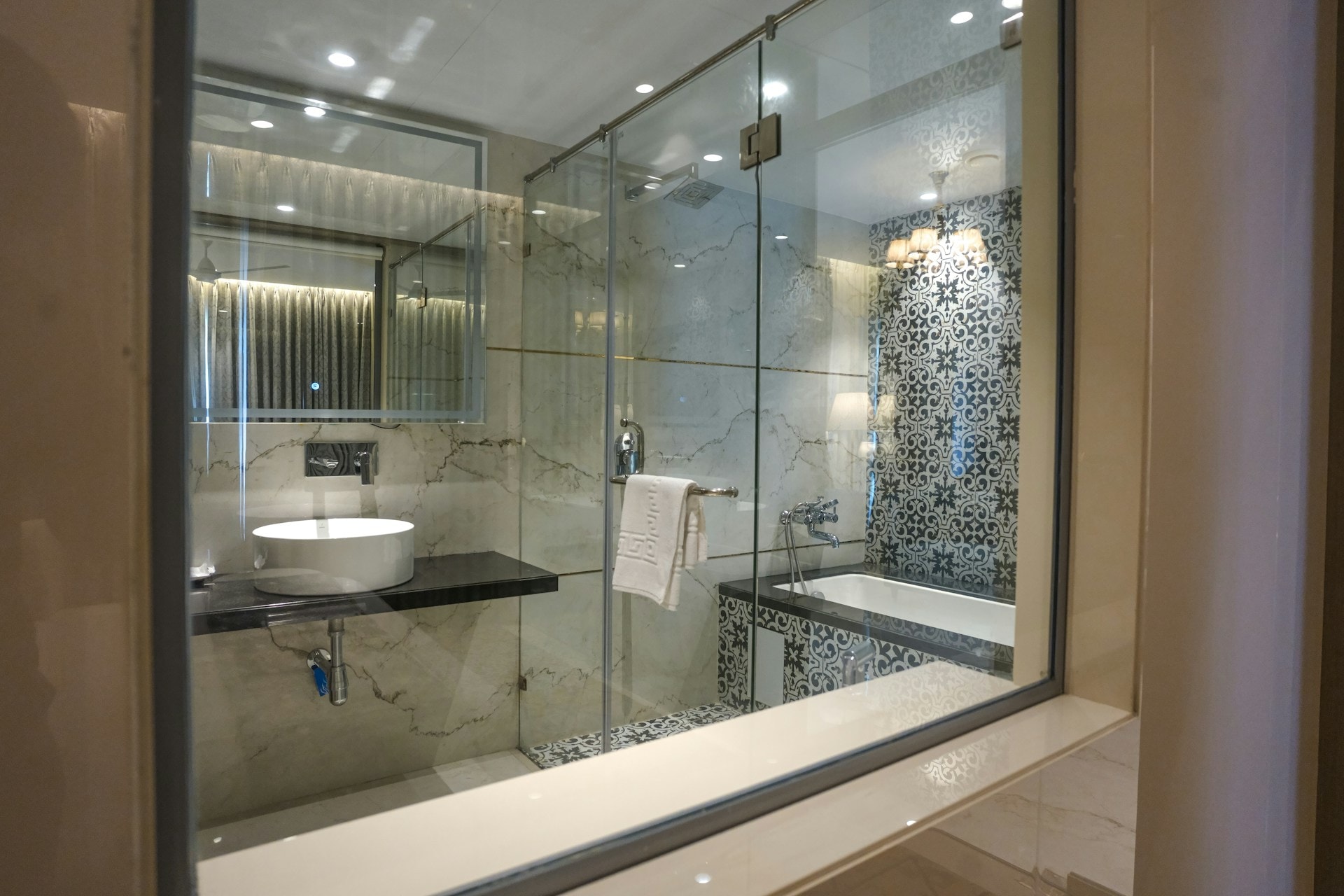
Hydraulic glass hinges are special hinges for glass doors that have a built-in hydraulic system. The hydraulic mechanism slows the last part of the closing movement, so the glass door closes softly and safely. These hinges are usually used on frameless glass doors, such as shower doors or interior glass doors.
Pros:
- Soft-close function
- Much quieter than regular glass hinges
- Safer for children or older people
- Help extend the life of the glass and hardware
Cons:
- More expensive than standard hinges
- Complex installation
Best for: frameless glass shower doors, interior glass doors
How to Choose the Right Door Hinge
With so many hinges available on the market, it can be quite difficult to choose the right one. So, how can you choose? Here are some tips!
1. Consider the Hinge Material
The hinge material plays a major role in durability and performance. Among the most common materials used for door hinges are stainless steel, brass, and solid iron.
- Stainless steel is one of the best materials for exterior and high-moisture environments because it resists rust and corrosion.
- Brass is a non-corrosive and rust-resistant material that is also decorative, but it is not as strong as steel.
- Bronze is attractive, corrosion-resistant, and self-lubricating, which means it won't squeak over time.
- Hinges can be finished in various ways, including polished, brushed, or plated finishes to complement the design of the application.
- Rust-resistant finishes are applied to hinges to prevent corrosion and maintain their appearance over time.
- For bathrooms, kitchens, and outdoor doors, stainless steel is usually the best long-term choice.
2. Match the Hinge to Your Door Size and Weight
Not all hinges can handle the same door size and weight.
- Small, lightweight doors can use standard hinges.
- Large or solid-core doors need heavy-duty hinges like ball bearing or continuous (piano) hinges.
- As a general rule, most hinges work well for standard interior doors, but oversized or solid wood doors require stronger hinge designs.
3. Think About Cabinet Construction: Face Frame vs Frameless
For cabinets, you must know whether your cabinet has a face frame or a frameless (European-style) construction.
- Face-frame cabinets often require specific overlay or inset hinges.
- Frameless cabinets typically use concealed European hinges.
Choosing the wrong hinge style can prevent the door from aligning or closing properly.
4. Decide If You Need Extra Features
Some doors benefit from specialty hinges:
- Soft-close hinges are ideal for cabinets and wardrobes because they prevent slamming and reduce wear.
- Self-closing or spring-loaded hinges are useful for doors that must shut automatically.
- Concealed hinges are best if you want a clean, modern look.
5. Check Opening Angle and Movement
Different hinges allow varying degrees of door opening.
- Standard hinges usually open to about 90°-110°.
- Some cabinet hinges allow 135° or even 170° opening for better access.
If you need wide access for closets or corner cabinets, choose a hinge designed for wider opening angles.
6. Choose the Right Number of Hinges
Using the correct number of hinges is just as important as choosing the right type.
- Tall or heavy doors often require three or more hinges.
- Smaller doors normally work well with two.
Using too few hinges can cause sagging and early wear, even if the hinge type itself is strong.
Door Hinges Types by Application
As a bonus (to help you find the best door hinges for your doors), we've grouped various door hinges types based on their application.
Cabinet Hinges Types
Common cabinet hinge types include:
- Concealed (European) hinges
- Soft-close hinges
- Overlay hinges (full overlay and half overlay)
- Inset hinges
- Knife hinges
- Barrel hinges
Bifold Door Hinges Types
Common bifold door hinge types include:
- Pivot hinges
- Top-mounted pivot hinges
- Bottom pivot hinges
- Concealed hinges (for flush bifold designs)
- Spring-loaded hinges
Entry Door Hinges Types
Common entry door hinge types include:
- Butt hinges
- Ball bearing hinges
- Security hinges (non-removable pin hinges)
- Continuous (piano) hinges
- Spring hinges
Glass Door Hinges Types
Common glass door hinge types include:
- Clamp-on glass hinges
- Pivot glass hinges
- Hydraulic glass hinges
- Floor spring hinges
Interior Door Hinges Types
Common interior door hinge types include:
- Butt hinges
- Concealed hinges
- Spring hinges
- Pivot hinges
- Rising butt hinges
Frequently Asked Questions
How many types of door hinges are there?
There are over 20 commonly used types of door hinges, and even more specialized designs for cabinets, glass doors, and industrial applications.
What is the 7/11 hinge rule?
The 7/11 hinge rule is a guideline for hinge placement where the top hinge is placed 7 inches from the top of the door, and the bottom hinge is placed 11 inches from the bottom. This helps distribute the door's weight evenly and prevents sagging over time, but it's not a definitive rule and it does not work for all doors.
Which hinges are best for internal doors?
Butt hinges and ball bearing hinges are the most popular and reliable options for internal doors. For lightweight doors, flush hinges also work well and are easier to install.
What are the different hinge styles?
Common hinge styles include butt hinges, ball bearing hinges, concealed hinges, piano hinges, pivot hinges, strap hinges, and spring hinges. Hinges can also be categorized by visible or concealed designs and by special functions like soft-close or self-closing.
What is the main advantage of using ball bearing hinges?
The main advantage of using ball bearing hinges is their ability to reduce friction, ensuring smooth operation for heavy and frequently used doors. This makes them an excellent choice for durability and ease of use.
Why are spring-loaded butt hinges useful in high-traffic areas?
Spring-loaded butt hinges are beneficial in high-traffic areas because they automatically close doors, reducing the need for manual operation and maintaining door security and access efficiency.