Front Doors
Black Front Door: Read This Before Installing One!
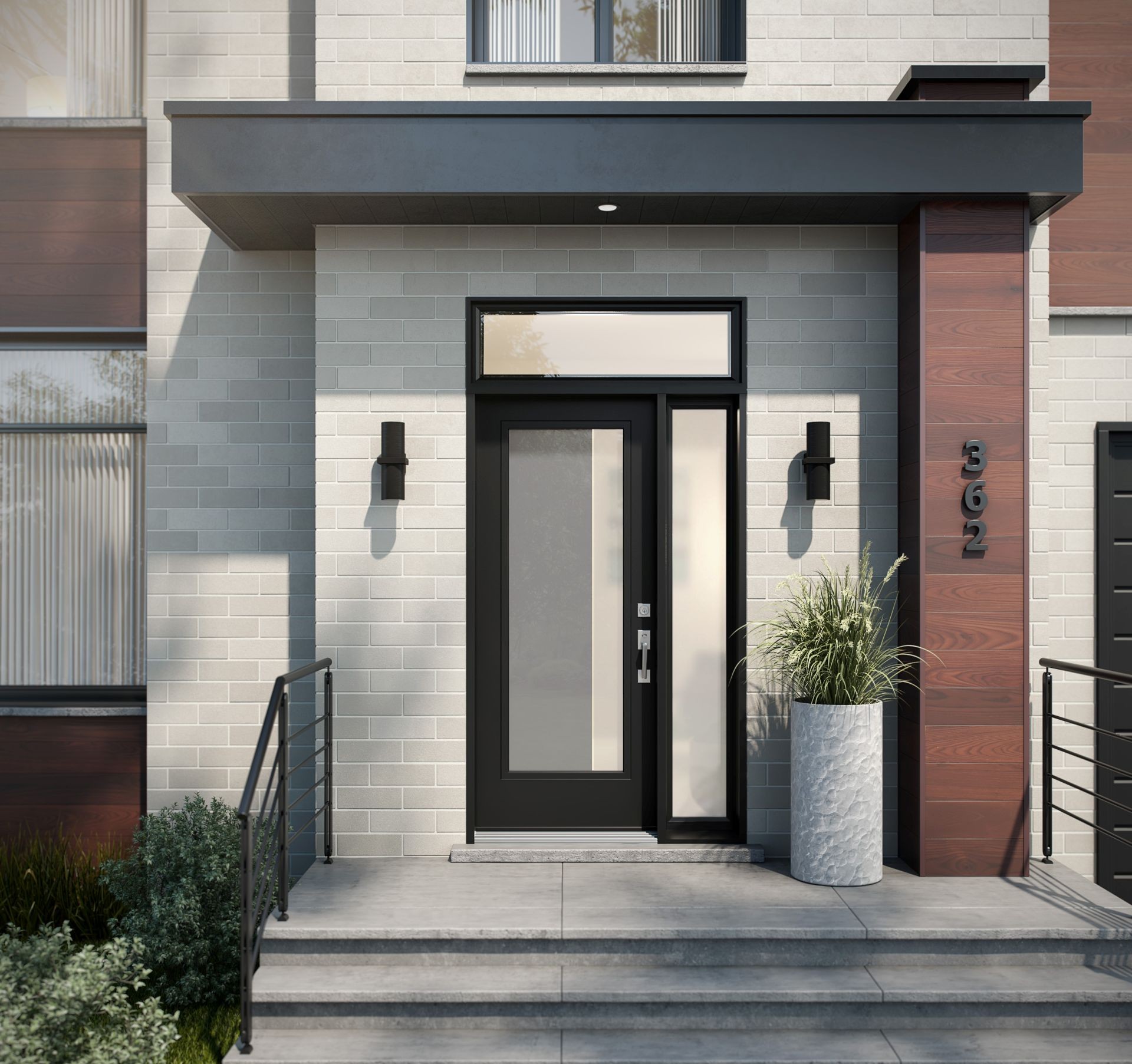
Recent real estate statistics show that homes with black front doors sell faster and for roughly $6,500 more than similar homes. No wonder black front doors have become so popular! They're elegant, stylish, and can create an interesting focal point on the facade, especially when paired wisely with hardware and trim.
On the other hand, a black front door does not suit every home. It might, in fact, look quite bad on some facades, appearing too imposing or giving negative vibes. So, if you want a black front door, make sure it really suits your home - and we're here to help you understand how!
Key Takeaways
- Black front doors can increase home resale value (~$6,500, according to statistics).
- Black front doors require proper insulation and thermal breaks to prevent heat transfer in sunny locations.
- High-quality paint can extend a black front door's lifespan and appearance.
Are Black Front Doors a Good Idea?

Black front doors are definitely an excellent idea. In fact, in 2025, black was the second most popular choice for front door colours - after all, it is a classic bold choice! Unlike trendy colored doors that may look dated within a few years, black front doors maintain their sophisticated appeal for decades. Because of this, black is an excellent choice for homeowners considering long-term resale value.
Moreover, from a design and architectural standpoint, black front doors affect balance, proportion, and visual hierarchy. And in Feng Shui, black is associated with positive energy, wisdom, and wealth, despite it being dark.
And here's exactly how black front doors can improve your home's curb appeal!
A Strong Focal Point
Every facade needs a point of emphasis. And a black entry door could be perfect for that! It is naturally attention-grabbing because the human brain is programmed to notice strong contrasts. This can make the entryway appear clearly defined without excessive decoration.
Anchoring the Home’s Visual Composition
Architecturally, dark tones at the base or center of a structure create visual stability. A black door (even better if you go for double doors) works almost like an anchor, helping tie together multiple materials into a cohesive whole. So, if your home has several textures or colors, the black door can unify them.
Design Flexibility
Designers value black because it behaves like a “neutral plus.” In traditional architecture, it enhances symmetry and reinforces formal proportions. In modern architecture, it accentuates clean lines and provides contrast without adding visual clutter.
Added Depth and Detail
Dark colors recede visually, which can make a door look more refined. Panels, glass inserts, and trim profiles often appear sharper and more intentional when painted black. Instead of seeing a flat surface, you see shadow and dimension, which elevates the overall craftsmanship.
Elevated Hardware and Lighting Fixtures
Architects often treat the front door as one of the most important elements of a facade. With a black door, the hardware (handleset, knocker, hinge) gets a completely different look, especially if paired wisely.
Compatibility with Different Materials
Black works with numerous materials and colours: white siding, gray stucco, red brick, natural stone, warm wood... In fact, many designers turn to black doors because they do not compete with surrounding colours and blend seamlessly with various palettes.
Timeless Sophistications
Unlike some color trends that date quickly, black maintains a sense of timelessness. Historically, it’s been used in both heritage buildings and contemporary architecture, so it feels rooted yet current. This makes it a safe design investment.
Greater Home Value
Curb appeal studies repeatedly show that black or very dark-colored doors signal “premium,” just as we've mentioned earlier in our article. They suggest intentional home design, good maintenance, and a higher-end aesthetic, all of which matter to potential buyers.
Low-Maintenance and Hidden Imperfections
Depending on its finish, a black door can show dust and fingerprints more readily than light-colored doors, requiring a regular maintenance routine. Weather-related wear, on the other hand, is less noticeable on black doors. Moreover, with proper exterior paint or a high-quality satin finish, upkeep is simpler than many homeowners expect.
Black Front Door: Climate & Orientation Checklist

Sun Exposure
- South- and west-facing doors: high heat and UV exposure; choose insulated fiberglass or insulated steel black doors like those manufactured by Magic.
- East-facing doors: morning sun can cause glare on glass panels; consider tinted or low-E glazing.
- North-facing doors: higher moisture exposure; wood black doors may need extra sealing or protection.
Climate Considerations
- Hot/sunny regions: use cool-black pigments or UV-resistant finishes on your black entry door to reduce heat absorption and fading.
- Cold climates: prioritize black exterior doors with insulated cores, warm-edge glazing, and tight weatherstripping.
- Humid or coastal areas: select corrosion-resistant hardware and powder-coated metal finishes for your black entry door.
Architectural Protection
- Install your black front door under a deep overhang or recessed entry to shield from sun, rain, and wind.
- Use shading elements like pergolas, awnings, or landscaping to reduce direct solar load.
- Ensure proper sealing and thresholds to maintain energy efficiency and prevent water intrusion.
Material Recommendations Based on Exposure
- High heat & sun: fiberglass or insulated steel with UV-resistant coatings.
- Moisture-prone areas: fiberglass or powder-coated aluminum.
- Moderate, protected areas: wood or engineered wood can be used with regular maintenance.
Best Materials for Black Front Doors
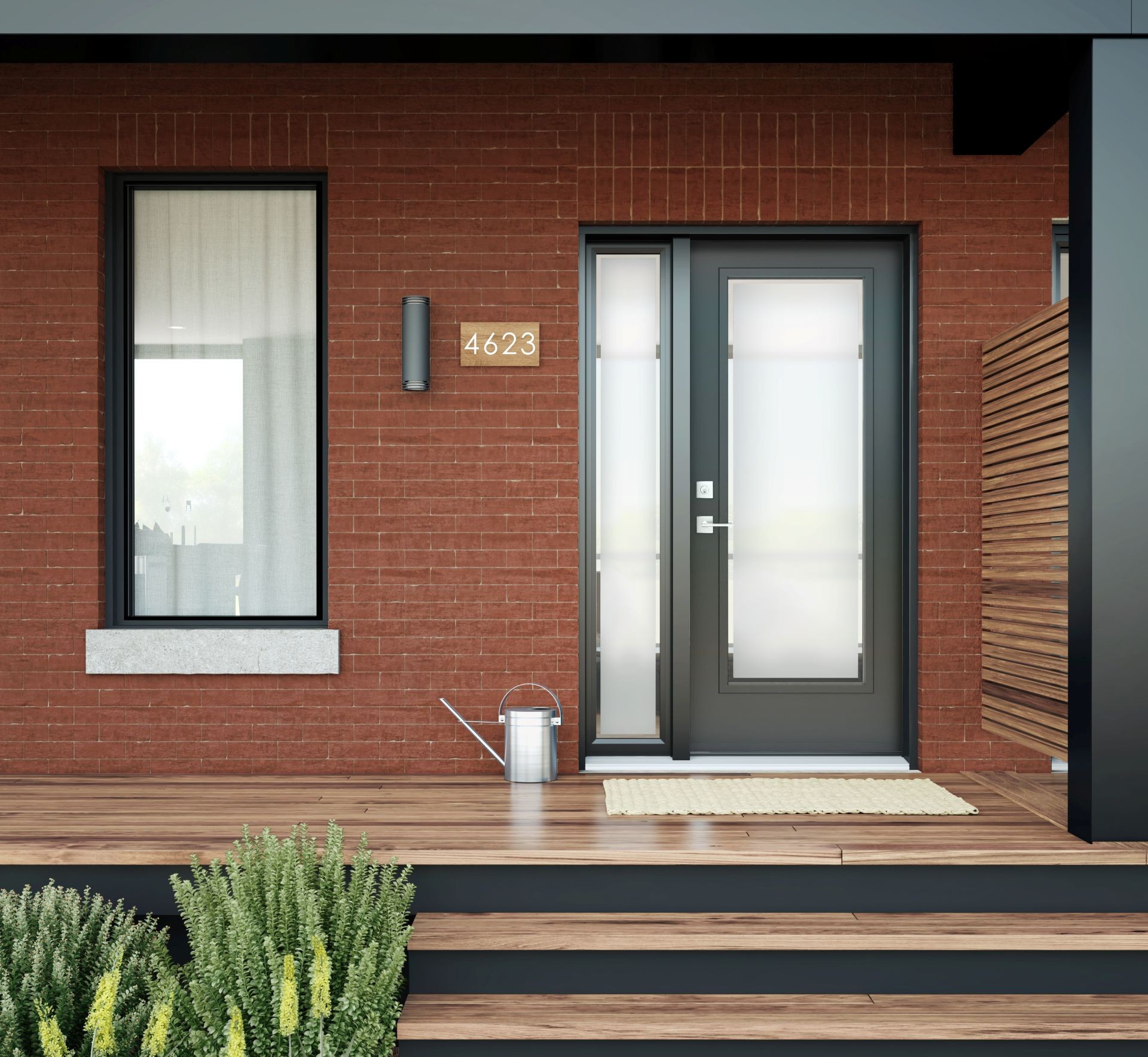
The material you choose for your black front door will influence how the door looks, functions, and performs. In the following sections, we'll discuss different exterior door materials and whether they're suitable for black exterior doors.
Before we go into more details, here's a quick breakdown of the main differences between the most popular entry door materials:
Solid Wood Black Front Doors
- Appearance & finish
- Wood gives a warm, premium appearance. When painted black, wood grain can add subtle depth.
- Thermal performance & insulation
- Generally lower insulation than foam-core doors unless reinforced.
- In direct sun, dark paint causes the surface to heat and the wood can expand/contract, which increases the risk of warping and cracking over years.
- Durability & UV/heat behavior
- Vulnerable to UV/drying unless sealed with a high-quality exterior coating and maintained.
- Best used where the door is protected (porch/overhang) or if you commit to regular finish maintenance.
- Security/structure & maintenance
- Very repairable. Dents and scratches can be sanded and refinished.
- Requires periodic repainting/refinishing every few years, depending on exposure to the elements; susceptible to water damage.
Fiberglass Black Front Doors
- Appearance & finish
- Can mimic wood grain or be perfectly smooth. Black finish on fiberglass looks consistent and can be factory-applied (more durable) or site-painted.
- Thermal performance & insulation
- Frequently manufactured with polyurethane foam cores for excellent insulation (high R-value compared to hollow wood).
- Stable under thermal cycling; less expansion/warping than wood.
- Durability & UV/heat behavior
- Highly resistant to moisture and rot; better UV performance than wood when painted with quality coatings or factory finishes.
- Because fiberglass doesn’t move as much with temperature, paint adhesion and finish longevity tend to be better.
- Security/structure & maintenance
- Not as inherently strong as steel but very durable.
- Requires less maintenance: just needs regular cleaning with a soft cloth and occasional repainting, but only after many years.
Steel Black Front Doors

- Appearance & finish
- Usually flat, can work with a smooth black finish or powder-coat. Modern steel doors can be sleek and very clean-looking.
- Thermal performance & insulation
- Varies: cheapest steel doors are hollow and poorly insulated; modern exterior steel doors have a polyurethane foam or polystyrene core that gives them a good R-value.
- Durability & UV/heat behavior
- Very durable structurally; prone to rust/corrosion if the finish is damaged or if the door is installed in coastal environments unless engineered for corrosion resistance.
- Dark finish can heat the skin of the door, but when paired with an insulated core, this should not be an issue.
- Security/structure & maintenance
- Excellent for enhanced security. Dents are possible and sometimes difficult to repair completely.
- Touch-up paint and rust prevention are important if the finish is scratched.
Aluminum Black Front doors
- Appearance & finish
- Great for modern black doors with narrow-profile frames and large glazing areas. Powder-coated black aluminum looks sleek.
- Often used in commercial/modern residential entrances.
- Thermal performance & insulation
- Aluminum is not a good insulator, so aluminum doors must have thermal breaks and insulating cores to achieve a good R-value.
- Without thermal breaks, aluminum doors can create condensation and heat transfer issues.
- Durability & UV/heat behavior
- Powder-coating resists fading and corrosion; very good in humid environments if marine-grade coatings and stainless hardware are used.
- Security/structure & maintenance
- Durable but not as strong and secure as steel.
- Generally low maintenance
Paint, Coatings, and Black Door Finishes

The paint, coatings, and finishes you choose are just as important as the door material itself!
Factory Applied vs. Field Painting
Factory-applied finishes are often the most durable for metal and fiberglass. If available, choose these over field painting.
If you need to paint the door yourself, use a high-quality exterior 100% acrylic latex, as it has excellent UV resistance and flexibility.
Recommended Black Paint Types and Sheens
For metal (steel/aluminum) doors, make sure to apply a rust-inhibiting primer before topcoat. For fiberglass doors, use a bonding primer formulated for non-porous surfaces, then acrylic latex topcoat. For wood doors, apply a high-build exterior primer, two coats of UV-stable exterior paint, and consider a UV-resistant clear coat for extra protection.
Furthermore, it is recommended a satin/eggshell finish for black doors. It hides minor surface irregularities, and it's easier to clean. Matte black is not the best choice for exterior doors - it shows dirt and oils quickly, it's more difficult to clean, and it can get scratched easily.
Black Door Hardware
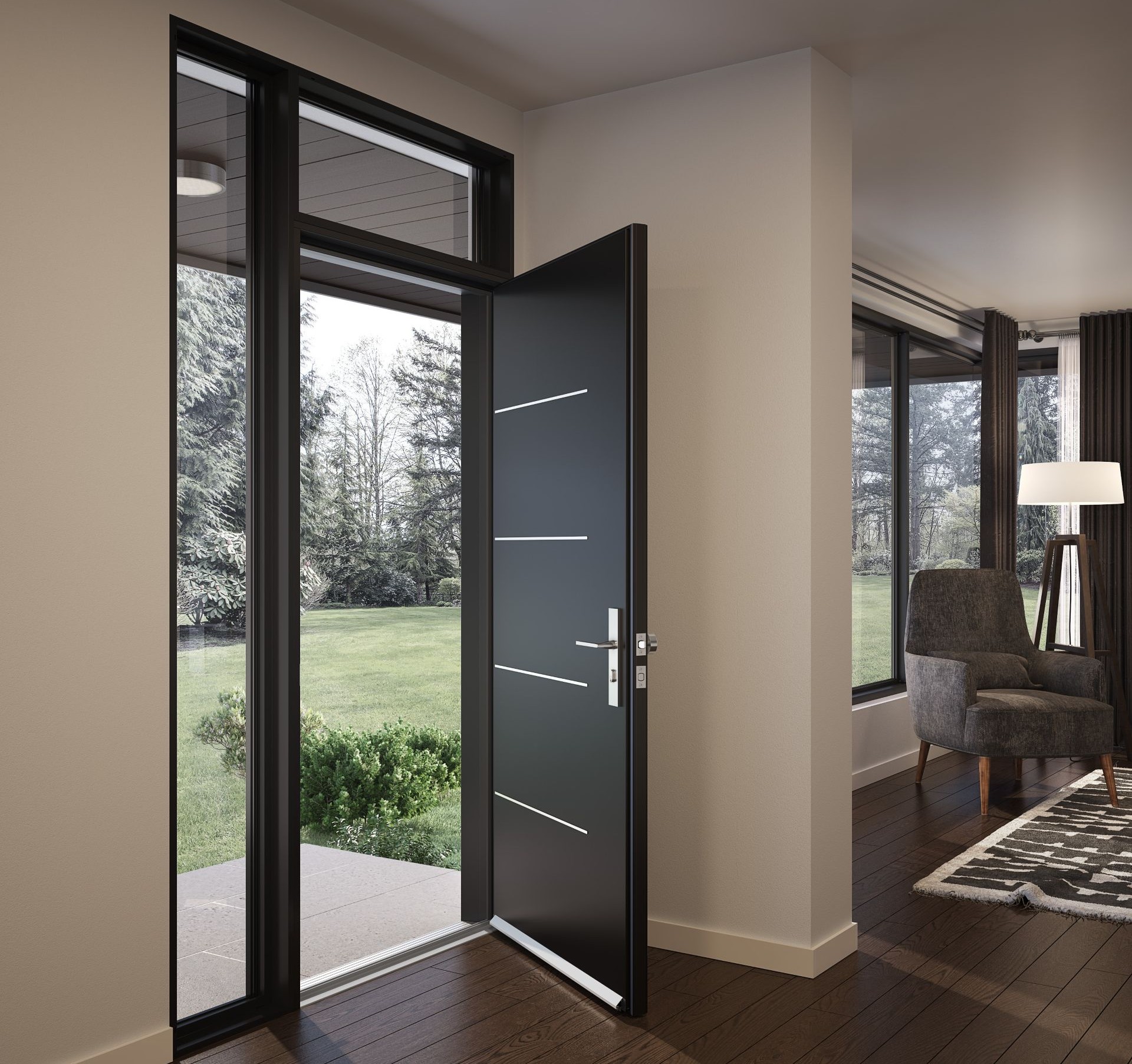
Black shows hardware contrast beautifully. So, for hardware, choose finishes like brass, aged bronze, satin nickel, or matte black. Make sure the finishes are plated for longevity.
Furthermore, make sure that the hinges, locks, strike plates, and handles are corrosion-resistant, especially if you live in a coastal region.
Black Front Door Glazing Options

Sometimes, black doors can appear too imposing if not equipped with a glazing area - both on the outside and on the inside. On the other hand, if you install sidelights, transoms, or glass inserts, the dark frame will sharpen the perceived brightness and clarity of the glass and give the entry a clean, architectural presence.
You can choose:
- Clear insulated glass for maximum natural light.
- Frosted glass, which softens the contrasts and provides privacy; it also allows some natural light in, but not as much as clear glass.
- Decorative glass, which is excellent for traditional homes.
- Tinted glass, which aligns with monochromatic palettes.
- Impact-resistant glass if security is a major concern.
Energy Efficiency Tips for Black Entry Doors
And don't forget the most important aspect: black absorbs more solar radiation than lighter finishes, which means the door system must be engineered for thermal stability. Energy performance depends on three core factors: the door material, the glazing performance, and the sealing materials.
Door Material and Insulation
- A polyurethane foam core, common in high-quality fiberglass and steel doors, provides strong R-values and reduces heat transfer.
- Wood, although visually appealing, does not insulate as efficiently and is more sensitive to the expansion caused by temperature differences, particularly on south- or west-facing exposures where dark doors heat up significantly.
Glazing Performance
- Insulated glazing units (IGUs) with double or triple panes, argon or krypton gas fills, and warm-edge spacers significantly improve the thermal resistance of any glass used in the door.
- Low-E coatings are critical in a black door configuration. They help counteract the door’s natural heat absorption by reflecting infrared radiation, maintaining stable interior temperatures, and reducing HVAC loads.
Sealing Materials
- Thermally broken frames, especially on aluminum or metal-clad door systems, prevent heat from traveling directly through the frame.
- High-quality weatherstripping, multi-point locking systems, and insulated thresholds ensure that the thermal performance of the door and glass panels is not lost through air leakage or conductive heat at the sill.
- A correctly engineered black door should not feel hot on the interior side, even during peak sun exposure.

Design Coordination
A black door immediately becomes a visual anchor on the façade, so the design coordination must be deliberate. Unlike mid-tone colors that blend easily, black requires a clear architectural rationale.
Firstly, the proportions of the door (panel layout, glass placement, stile and rail sizing) must align with the architectural language of the home.
Secondly, the door colour should relate to at least one other fixed exterior element: window frames, roof fascia, metal accents, shutters, or railings. When black appears only once on a façade, it risks looking arbitrary.
Thirdly, hardware choice is fundamental. Black hardware produces a monolithic, sculptural effect, brass adds warmth, while nickel adds contrast and elevates the door’s detailing. Moreover, the hardware finish should coordinate with porch lighting, house numbers, and mailbox finishes to create a cohesive entry composition.
Last but not least, even landscaping and lighting can reinforce the presence of a black door! For instance, warm lighting temperatures accentuate the depth of the black finish in the evening, while structured planting near the entry, such as symmetrical planters, helps formalize the black door as the focal point.
The Magic Ultimate Entry Door: Black, Bold, and Built to Last
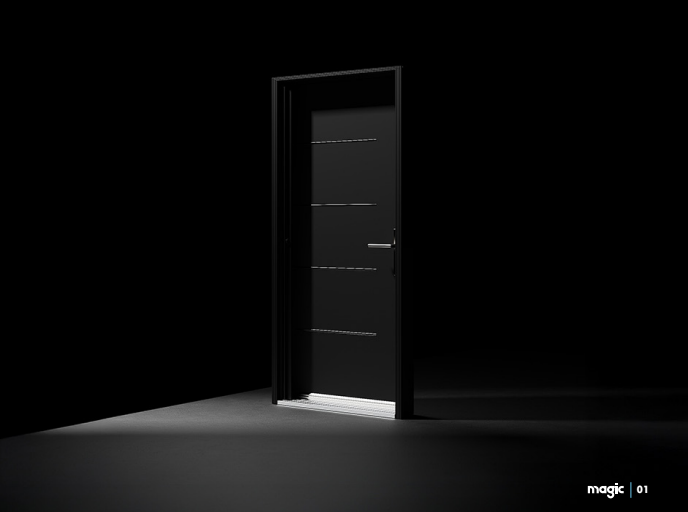
If you’ve made it this far, you know that a black front door is a stunning design choice, but it comes with a few "terms and conditions" regarding heat and durability. You might be worried that choosing black means signing up for warping, fading, or higher energy bills.
That’s exactly why we engineered the Magic Ultimate Entry Door. We didn't just paint a standard door black; we rebuilt the entry system from the core out to handle the unique demands of the Canadian climate, no matter what colour you choose for your renovation project.
Here is why it is the perfect candidate for your bold black entryway:
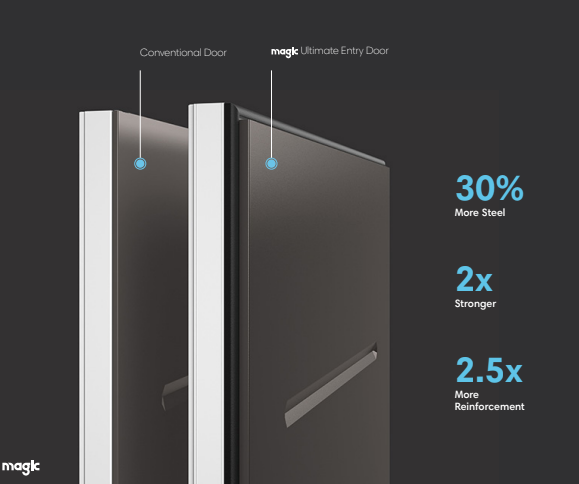
- It’s built like a vault (literally): standard doors can warp or bow under the heat absorbed by dark paint. Our door features a slab that has 40% more insulation and 30% more steel. In fact, it has withstood over 1,600 lbs of pressure in forced entry tests: three times more than conventional steel or fiberglass doors. That means your black door stays straight, secure, and true, even on the hottest summer days.
- A seal that actually seals: our proprietary U-channel design mechanically locks the slab's compression seal directly into the frame. This eliminates drafts and ensures that the heat absorbed by the black exterior stays outside, keeping your home comfortable.
- Customized to your vision: whether you want a sleek, modern matte black slab or a traditional look with sidelights and transoms, every Magic door is 100% made to order right here in Ontario. You get the style you crave without worrying about the "off-the-shelf" quality issues.
So, if you want a black front door that performs as beautifully as it looks, we're here to help you design it! Book your free consultation with Magic and let's find the perfect solution for your home!
Frequently Asked Questions
What hardware color should I choose for a black front door?
For a black front door, choose satin brass, aged bronze, or brushed nickel for the hardware. You can also go for matte black hardware for a black entry door.
How to paint a front door black?
To paint a front door black, you'll have to clean, sand, and prime the surface, then apply two to three thin coats of high-quality exterior paint using a brush for profiles and a roller for flat areas. Allow each coat to dry fully and finish with a durable satin or semi-gloss sheen for long-term performance.
What is the best black paint for a front door?
The best black paint for a front door is a premium exterior 100% acrylic latex.
How to choose a black front door handle set?
If you have a black front door, choose a handle set that matches your home's architectural style: sleek, linear hardware for modern looks and more sculpted profiles for traditional entries. Prioritize solid construction, weather-resistant finishes, and a finish that coordinates with surrounding exterior fixtures.
Is a black front door with sidelights a good idea?
Yes, sidelights pair well with a black door because the dark frame enhances the brightness and clarity of the glass, creating a strong architectural focal point. Just make sure that the glazing area is well insulated.
Does a black door get too hot in direct sunlight?
Black doors do absorb more heat than lighter colors, but modern insulated cores and thermal breaks minimize heat transfer into the home.
How often do black doors need repainting?
Quality factory finishes on fiberglass or steel doors typically maintain their appearance for 8-12 years before requiring attention. Wood doors may need refinishing every 5-8 years, depending on exposure and finish quality. Matte finishes generally last longer than high-gloss options, while premium UV-resistant coatings extend all finish types’ lifespan significantly.
Can I install a black door myself?
While you can install a black door yourself, it is recommended to seek professional help. Proper installation of a black front door is crucial to prevent drafts, water leaks, and security vulnerabilities. Professional installation requires specialized tools, knowledge of building codes, and experience with weatherproofing techniques.